Google Business Profile optimisation: the 11 fields that decide whether you appear in the map pack
The map pack above the search results is decided by eleven fields in your Google Business Profile. We go through them in order of weight, with real figures from Sint Niklaas and the mistakes we found in our own profile.
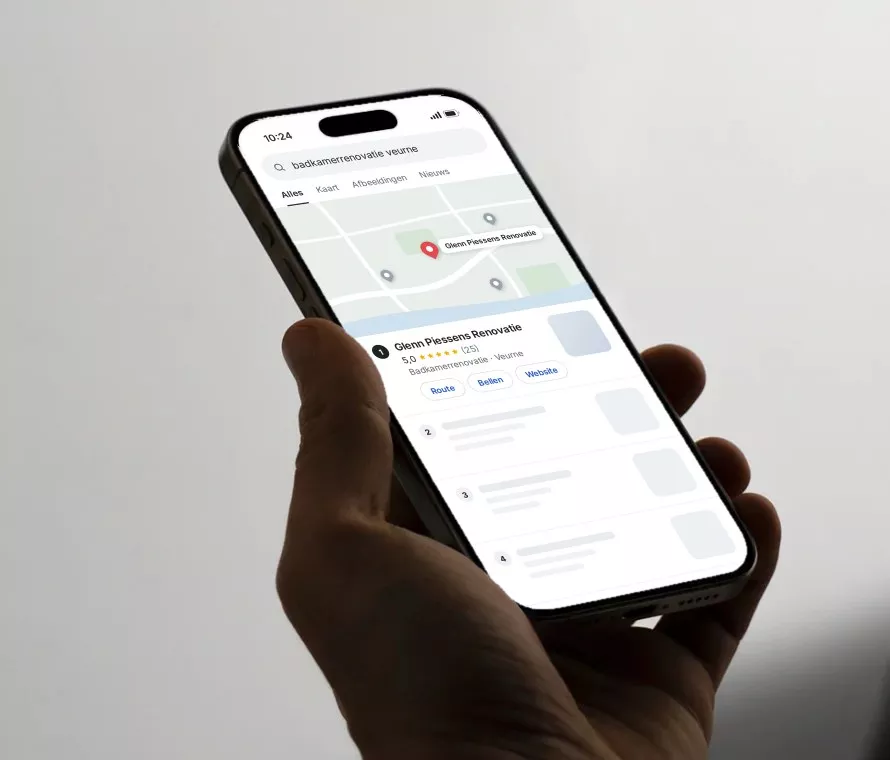
You type your own trade and your town into Google, just to see. A map with three businesses appears at the top. You are not one of them. The competitor two streets away is, even though they only started three years ago, and so is a company from Beveren you never knew worked in Sint Niklaas. You scroll on, and there you are, somewhere below the ads and the comparison sites, where hardly anyone looks.
Most business owners then blame their website, or their budget. Usually the cause is much smaller: a profile set up in ten minutes five years ago and never opened since. For this article we put our own profile through the same Google Business Profile optimisation we do for clients, and it was an eye opener. Not because it looked bad, but because it contained exactly the mistakes we always fix first for clients.
The short version
The map pack is not decided by your website or your budget, but by a handful of fields in your Google Business Profile. Here they are, in order of weight according to Whitespark’s annual expert survey, with what you can do about each one yourself.
| Field | What you fill in | Impact | Time |
|---|---|---|---|
| Primary category | The category that literally says what you do | the biggest factor you control yourself | 5 minutes |
| Business name | Your name as it appears on your shopfront and your invoices, with nothing added | big, but extra words are not allowed | 2 minutes |
| Address or service area | A real address, or the towns you work in | big | 10 minutes |
| Opening hours | When you can be reached, public holidays included | big, you only compete when you are open | 5 minutes |
| Additional categories | Only what is a substantial part of your work | medium | 5 minutes |
| Services | Each service separately, with its own description | medium | 30 minutes |
| Reviews | Number, recency and your replies | big and growing | ongoing |
| Photos | Your own photos of your work, your team and your premises | medium | 20 minutes |
| Description | 750 characters on what you do, for whom and where | small for ranking, big for the person reading it | 20 minutes |
| Website and phone | Exactly the same details as on your site | medium | 5 minutes |
| Attributes, questions, updates | What you offer, the questions you often get, a post now and then | small | 15 minutes |
All in all it takes you one afternoon, and it does not cost a cent. Figures and examples in this article are as of September 2026.
How does Google decide who appears in the map pack?
Google itself says local results are ranked on three factors: how well your profile matches what someone searches for, how close you are to the searcher, and how well known your business is. You cannot change the distance. You can change the other two, and that is exactly what the fields above are about.
Every year, dozens of people who manage profiles every day are asked what carries the most weight in practice. That is not a statement from Google, so read it as a direction. But the direction is clear, and it has been the same for years. This is the top of the Local Search Ranking Factors by Whitespark for the map pack, 2026 edition, converted to the score the experts gave each factor.
Of the ten heaviest factors, two are out of your hands: the distance to the searcher and whether your address is in the town being searched. One you are not allowed to use, and that is putting keywords in your name. The other seven are fields you can fill in today.
The most important field in your entire profile is a dropdown you can change in five minutes. Almost nobody does.
How to optimise your Google Business Profile, field by field
We go through them in order of importance, not in the order Google shows them. For each field you read what it does, what usually goes wrong and what to fill in.
Your primary category, the field that drives everything
Google lets you pick one main category from a fixed list. That single choice decides which searches you are even eligible for. A roofer who picked Contractor as their category does not compete when someone searches for a roofer. A physiotherapist with the category Health loses to the physiotherapist who simply chose Physiotherapist.
Choose the most specific category that describes your main activity. Not Construction company if you mostly do roofs, not Shop if you repair bikes. Not sure? Type your trade into Google and look at which category the three businesses in the map pack use. It usually sits right under their name.
Your business name, and why you add nothing to it
Keywords in your name carry a lot of weight, as the chart shows. That is why so many profiles carry a name like Janssens Roofing Sint Niklaas while the shopfront simply says Janssens. Google explicitly forbids this: your name must match what you use in the real world, and additions can get your profile suspended. Then you lose everything, your reviews included.
So don’t. If your business really is called Janssens Roofing, use that. Want the town to show up in the search results? It belongs in your services, your description and on your website, not in your name.
Address or service area
This is where construction firms and mobile services most often get it wrong. If you go to the client’s home and have no shop or showroom, hide your address and fill in a service area: the towns you work in. If you do have a place where clients walk in, show the address. If clients come to you and you also go to them, fill in both.
A real, visible address weighs more than a service area, as the seventh factor in the list shows. But a made up address, a PO box or your accountant’s address is a violation. If you have no address where clients can visit, work with your service area and put the town in your services and your description. For the results below the map you also need a location page of your own on your website, and why it outweighs your homepage is in our article on local SEO for contractors.
Opening hours, because you only compete when you are open
This is new in the 2026 top five, and it explains a lot. If someone searches for a plumber on Saturday morning and your profile says closed, you get shown less, even if you would happily come out that day. A tradesperson who can be reached from 7:00 to 18:00 but filled in nothing on their profile, or left the default 9:00 to 17:00, hands that Saturday to someone else.
Fill in your real hours. If you answer the phone on Saturdays, say so. And schedule your public holidays in advance: Google asks for them itself, and a profile that shows you as open on Christmas Day while you are at home earns you an angry review.
Additional categories
Besides your main category you can pick more. Only do so for what is a substantial part of your work. An electrician who also installs charging points adds EV charger installer. A painter who also hangs wallpaper adds Wallpaper installer. Ticking ten categories because you can is the quickest way to make Google doubt what you actually do.
Services, each one separately
Under your category you can add services, each with its own title and description. This is where you can mention your town, and where you can place keywords without breaking any rules. A roofer does not list Roofing, but Roof renovation, Flat roofs, Roof insulation, Gutters and Velux installation, each with two sentences on how he does it and where.
We see profiles with zero services and profiles with one service that says Everything. Neither tells Google anything. Use the same names as on your website, because Google compares the two.
Description
You get 750 characters. The description carries little weight for your position, but it is what a person reads before they call. Say what you do, for whom, in which towns, since when, and what you do differently from the rest. In plain sentences, speaking to the reader directly if your clients are private individuals. No list of keywords, no sentence that opens with Are you looking for.
Write it for the AI systems that now read it too. A profile that says in a full sentence that you are a roofer in Sint Niklaas specialising in flat roofs and roof insulation is something ChatGPT and Google’s AI answers can use. A row of loose keywords is not. How those systems choose their sources is explained on our page about being found in AI answers.
Photos
Your own photos, no stock images. Your van, your team, a building site from last week, the result of a job. Google asks for sharp, well lit images without heavy editing, and new material takes a day or two to appear. We recommend a fixed rhythm: two photos of every finished job, taken straight on site.
Reviews, the field that keeps growing
Three review factors are in the top eleven: your star rating, the number of reviews with text, and how recent they are. That is no coincidence. Reviews are the only field you cannot fill in yourself, so they tell Google something you cannot write yourself.
What customers expect was measured again in 2026 in BrightLocal’s Local Consumer Review Survey, among 1,002 American consumers. It is a different market, so treat it as a direction. But it is a firm one: 47 percent will not do business with a company that has fewer than twenty reviews, 74 percent only look at reviews from the last three months, and 80 percent prefer a business that replies to every review. Even template replies backfire: half drop out when every response reads the same.
How to ask for reviews without it getting awkward
- Ask when the work is done and the client is happy, in person, not three months later by email.
- Keep the direct review link of your profile ready on your phone and send it straight away by text or WhatsApp.
- Ask for two sentences on what exactly you did. A review with text weighs more than five stars without words.
- Reply to every review within the week, with something about that client and not about you.
- Never offer a discount or a gift in exchange for a review. It is forbidden, and Google has become good at spotting it.
Website and phone, exactly as on your site
Your name, address and phone number must be literally the same on your profile as on your website and everywhere else you are listed. Not roughly, literally. A mobile number on the profile and a landline on the site, or a BV suffix in one place and not in the other, makes it harder for Google to confirm it is the same business. That consistency sits at number fifteen in the list, higher than the completeness of your profile.
Add UTM parameters to the link to your website, so your analytics show how many visitors come from your profile. That way, three months from now, you know whether this work paid off.
Attributes, questions and updates
At the bottom of your profile sit the small fields: attributes such as payment options or accessibility, the questions and answers, and the posts. They carry little weight for your position, but they make your profile complete, and that is factor sixteen. Answer the questions you get on the phone every week there yourself, before someone else answers them half right.
You do not have to post every week. Google archives posts after six months, so make sure there is something new at least every six months: a finished job, a new service, a period when you cannot be reached.
What was wrong with our own Google Business Profile?
We promised to be honest, so here it is. We checked our own profile, as Google showed it in the summer of 2026, against the list above. This is what we found.
Five mistakes in Offlow’s profile
- The name read Offlow followed by Web design and branding. That is an addition that is not on our invoices, and we stopped doing branding a while ago. Exactly the mistake we warn about above.
- There was one category, Web designer. Not a single category for SEO, even though that is now our main service. Anyone searching for an SEO agency could not find us on the map.
- The services listed Graphic design, Web design and Website building. We no longer offer graphic design. SEO, Google Ads and webshops were missing.
- The description opened with Are you looking to have a professional website built for your company, in stiff, formal language, with a team of experienced developers and East Flanders as the only location. No Sint Niklaas, no Stekene, no Waasland, no price.
- Four reviews, all five stars, two of them about a logo. Eight photos. The roofers in the Sint Niklaas map pack have between 18 and 46, see below.
What that teaches us is not that we are sloppy. It teaches us that a profile has to move with your business, and that almost nobody updates it when the business changes. We went from logos to SEO, and our profile stayed stuck in the days when we still made logos. So do not only look at what is empty, but also at what is there and no longer true.

What do we see in the Sint Niklaas map pack?
Theory is nice, but we wanted to check it against a real search. For the Dutch search for a roofer in Sint Niklaas (“dakwerker Sint Niklaas”), typed in around 320 times a month, the map pack looked like this in September 2026.
| Position | Rating | Number of reviews | What stands out |
|---|---|---|---|
| 1 | 4.7 | 46 | Active for more than 20 years, address in Sint Niklaas |
| 2 | 5.0 | 18 | Open until 21:00 at the time of the search |
| 3 | 4.9 | 38 | Active for more than 35 years |
| 4, just outside the map | 4.8 | 55 | More reviews than number one, still not on the map |
| 5 | 5.0 | 7 | Town in the name |
| 6 | 5.0 | 1 | Town in the name |
Three things stand out. The three on the map each have at least eighteen reviews. All three show how long they have been in business, and number one also shows that it is based in Sint Niklaas itself. And number two, with the fewest reviews of the three, was open the longest at the time of the search. That is the Whitespark list in real life, a few streets from our office.
Something else stands out: a business with 55 reviews and a 4.8 rating sits in fourth place, and the two profiles with the town in their name are fifth and sixth. So it is not reviews alone, and a keyword in the name does not beat a complete profile. That is usually the difference between third and fourth place.
A quick calculation: what is a spot in the map pack worth?
Take an electrician in Sint Niklaas. People search for an electrician in Sint Niklaas about 260 times a month, and that is before counting the surrounding towns and terms like charging point installation. We deliberately keep the maths conservative.
Say four in ten searchers click on one of the three profiles on the map, and as one of those three you get a third of those clicks. That is 35 people a month opening your profile. Say one in five of them calls or sends an enquiry, and you win one in three enquiries. With an average job of €2,500 and a 20 percent margin, that is €500 profit per job.
| What | Figure |
|---|---|
| Searches per month for an electrician in Sint Niklaas | about 260 |
| Searchers who click on the map pack | about 104 |
| Of those, to your profile, as one of the three | about 35 |
| Enquiries per month | 7 |
| Jobs from those enquiries | 2 |
| Profit per month | €1,000 |
| Cost of filling in the profile | one afternoon |
Two jobs a month from one search term, for one afternoon of work you do once. And if you are in sixth place today, your share of that is zero, because below the map very few people click More businesses. Run the numbers with your own average job. Even if you scrap half of our assumptions, it is still the best paid afternoon of your year.
What can you do yourself this week? A 10 step checklist
This is the Google Business Profile optimisation we work through first for every new SEO client. You can get through it in one afternoon.
- Type your trade plus your town into Google on your phone and note your position on the map. That is your baseline.
- Open your profile via Google Maps and check whether the category literally says what you do. Compare it with the three in the map pack and adjust where needed.
- Remove every addition from your name that is not on your invoice. Yes, the town too.
- Fill in your real opening hours, including Saturday if you can be reached then, and schedule this year’s public holidays right away.
- Add each service separately with two sentences, with the town in them, and with the same names as on your website.
- Rewrite your description in plain sentences: what, for whom, where, since when. Read it out loud. If it sounds like a brochure, start again.
- Upload ten of your own photos of work from this year and remove everything older than three years.
- Check that your name, address and phone number on your profile are exactly the same as on your website, down to the space after BV.
- This week, ask five happy clients for a review, in person, with the link ready, and reply to every review you already have.
- Put it in your calendar: in four weeks, search for your trade plus your town again and compare with your baseline.
Ten steps, zero cost. It is work we also do as part of the nine steps to rank higher in Google, and it is the only one of those nine you can do entirely yourself.
The mistakes we see most often
After more than 160 websites, we have looked inside plenty of profiles too. These are the mistakes that keep coming back, and every one of them costs you positions on the map.
Nobody can log in to the profile anymore
The profile was set up years ago by a nephew, a previous web designer or an employee who has since left, and nobody can get in. Meanwhile Google changes details itself based on what users suggest, and you only notice when your profile says closed. Sort out access first, before you touch the fields.
Two profiles for the same business
An old profile at the previous address and a new one at the current address. Google sees two businesses with the same name and the same number, and trusts neither. Have the old one removed or merged, and do not simply create a third.
The category is too broad
Contractor instead of Roofing contractor. Shop instead of Bicycle shop. Health instead of Physiotherapist. It feels safe because it covers everything, but to Google it covers nothing. Choose the narrowest category that is correct.
Showing an address where nobody can visit
Showing a home address as a business location is not only a violation, it also brings people to your front door. If you work at the client’s place, hide your address and fill in your service area. Google then shows you in the towns you list, even without a visible address.
Asking for all your reviews at once
Twenty reviews in one week after an appeal on Facebook, then a year of nothing. Google sees that pattern, and it is no coincidence that the fourteenth factor in the list is a steady flow of reviews. Five a month for twelve months weighs more than sixty in January.
When is this not worth your time?
There are three situations where you are better off closing this article and spending your time elsewhere.
If you only work as a subcontractor for two regular contractors, you do not need to be on any map. If you sell something that is searched for twenty times a month across the whole Waasland region, the map pack will not bring you clients, however good it looks. And if you have no address and no fixed service area, because you work on location all over Flanders for example, the map pack is not your channel. You need to be in the regular results, with a page per service and per region.
For everyone else: this is the cheapest win in local visibility there is, and almost nobody takes it.
Where does the profile stop and your website begin?
A good profile gets you on the map. It does not automatically get you the client. The same BrightLocal research shows that more than half of people still open your website after reading good reviews. If they land on a page from 2019 with no price and no clear button, you still lose them. Why that happens so often is explained in our piece on a website with visitors but no enquiries.
And the profile only works for the town you are based in. Want to be found in Beveren, Temse and Lokeren too? Then you need pages on your site about those towns. That is the work we do in an SEO programme for local businesses: fixing the profile is step one, followed by a page per service and per town. If you work in construction, the full order is in our step by step plan on how a construction company gets to the top in the Waasland region.
Want to know where you stand today, technically too? The SEO audit is where we put everything side by side: your profile, your site, your positions and those of your competitor, by name. A one time fix for a business in one town is available from €349, a monthly plan from €249, all excluding VAT and as of September 2026. But the profile itself you do first, and you do it for free. What you can still do yourself after that, and what you are better off handing over, is covered in outsource SEO or do it yourself.

Frequently asked questions
How do I get my business on Google Maps?
First search for your business name in Google Maps. If you find a profile you did not create yourself, click Claim this business. If you find nothing, create a new profile via Google Maps and go through the verification. That happens by phone, email, video or letter, and can take up to five working days.
How long do Google Business Profile changes take to work?
Photos and details usually appear within one to two days. You often see movement on the map within one to three weeks of fixing your category, your services and your hours. Reviews keep working as long as they keep coming in.
How many reviews do I need to appear in the map pack?
Google does not give a number. In the Sint Niklaas map pack we see 18 to 46 reviews for the top three roofers. More important than the number is that new ones come in regularly and that you reply to every review.
Can I put my town in my business name?
Only if it really is part of your name, on your shopfront and on your invoices. Otherwise it is a violation that can cost you your profile. Put the town in your services, your description and on your website.
Is Google My Business the same as Google Business Profile?
Yes, it is the same service under a new name. The separate app no longer exists. You manage your profile directly in Google Search and Google Maps. Older guides send you to buttons that have moved.
Does a good profile also help you appear in ChatGPT and Google’s AI answers?
For Google’s AI answers, yes, because they read your profile directly. For ChatGPT, what counts most is what is written about you on your website and on other sites. Whether you are already mentioned today, you can check in five minutes with our test to see if ChatGPT mentions your business.
Want to know if your profile is holding you back?
Request your free audit. Your Google Business Profile is a fixed part of it, alongside your positions and those of your competitor, by name. Within 24 hours on working days you get a report in your inbox, with every issue and everything that needs fixing. Prefer to talk first? Send Silvio a message or call 0495 46 80 90.
Would you rather we took care of it?
Tell us briefly what your business does and what you need your website to bring in. Silvio reads every enquiry himself and replies by the next working day.


