Does ChatGPT mention your business? Test your ChatGPT SEO in 5 minutes
A client who asks ChatGPT who to hire gets three or four names. With these five questions you'll know within fifteen minutes whether your business is one of them.
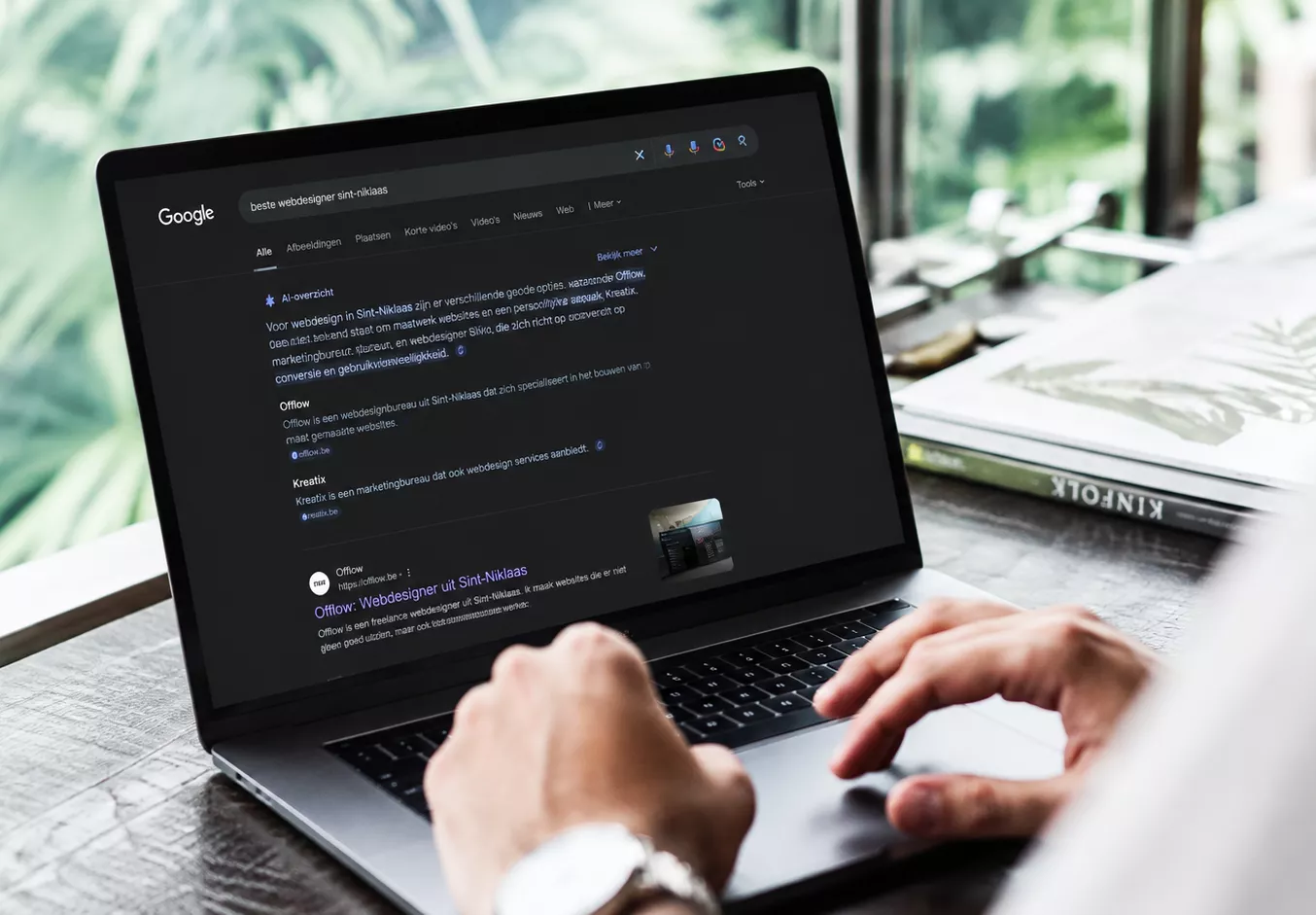
One of our clients, a roofer, got a call last month from someone who said: “I asked ChatGPT and it sent me to you”. Nice. That is ChatGPT SEO at work. That same week, another business owner from the same region tried it for his own company and got three competitors. His name wasn’t on the list.
The annoying part is that you don’t notice. With Google, Search Console at least shows you that your impressions are dropping. When an AI doesn’t mention your business, the phone simply doesn’t ring and you never find out you weren’t on the list. You just keep thinking it’s a quiet month.
The short version
You can test it yourself in five minutes. Open ChatGPT, ask five questions the way a client would ask them and write down what comes out.
| Test | What you ask | What you want to see |
|---|---|---|
| 1. The cold question | your service plus your town, without your name | your business in the list |
| 2. The name question | what do you know about [your business] | what it says is correct |
| 3. The comparison | who is the best [service] in [region] | you are in it, with a reason |
| 4. The source question | where did you get that from | your own site as a source |
| 5. The price question | what does [service] cost in [town] | your prices, not someone else’s |
If you don’t show up in any of the answers, that is not a disaster and not a punishment either. It means your site has too little on it that an AI can work with. That can be fixed, and the rest of this article explains how.
Why this can’t wait any longer
In 2025, 42 percent of Belgians aged 16 to 74 used a generative AI tool in the previous three months, for personal use, work or study. For personal use alone, it is one in three. That figure comes from the FPS Economy, not from a marketing agency trying to sell you something.
On top of that, Google increasingly shows its own answer at the top of the results instead of ten blue links. People who read that answer often don’t click through any more. So the question is no longer just “am I at the top of Google”, but also “am I mentioned in the answer people actually get to see”.
With Google, you can see yourself slipping. With AI, you just hear nothing, and that is what makes it so easy to miss.
The good news: almost nobody in construction, healthcare or local services is working on this today. Act now and you will be in those answers a year from now, while the rest are still waiting.
The five minute test: exactly what to type into ChatGPT
Open ChatGPT in a new chat. Important: log out or use a new chat without memory, otherwise what the AI already knows about you colours the answer. Replace the parts in brackets with your own details.
- The cold question. “I’m looking for a [roofer] in [Stekene]. Who do you recommend?” This is the question a real client asks. Write down every name that comes out, in order.
- The name question. “What do you know about [your company name] from [your town]?” Don’t just check whether it knows you. Above all, check whether what it says is correct. Outdated opening hours, an old address or a service you no longer offer is worse than nothing.
- The comparison. “Who are the best [roofers] in [the Waasland region] and why?” This shows what you are known for: price, speed or specialisation. If nothing comes up about you, your site doesn’t give you a clear profile.
- The source question. Right after answer 1 or 3, ask: “Where do you get that information from? List the sources.” Now you see which websites the AI uses. If your site isn’t there but a competitor’s is, you know exactly where the problem is.
- The price question. “What does [replacing a flat roof] cost in [the Waasland region]?” If the AI shows your competitor’s prices here and not yours, you lose the comparison before anyone even visits your site.
Ask the same five questions in Google itself too and see whether an AI answer appears at the top. And if you have five more minutes, repeat them in Perplexity. It shows its sources by default, which makes the exercise a lot faster.
What do ChatGPT’s answers tell you?
Five outcomes, five meanings. Find the one that fits you.
| What you see | What it means | What you do about it |
|---|---|---|
| You are not mentioned | Your site has too little on it that an AI can quote | Pages per service and per town, with concrete answers |
| You are mentioned, but wrongly | Old details are still online somewhere | Correct your Business Profile, your listings and your own site |
| You are mentioned without a reason | Your profile is too vague | Make it clear what you specialise in |
| Only your competitor is in it | Their copy is easier to quote | See which questions they answer and answer them better |
| The AI shows no local business at all | Nobody in your sector has built anything yet | Start now, the spot is still open |
That last row is the most interesting one. In quite a few local sectors, not one business says clearly on its site what it does and where. So the AI fills the answer with whatever it finds in a business directory or on a comparison site. Getting in there is easier than reaching the top of Google.

Where does ChatGPT get its answers from?
Put simply, from three sources.
From what the model has learned. That is a snapshot of the web from some time ago. Your page from last month isn’t in it yet. You can’t change anything here in the short term.
From live search results. ChatGPT, Perplexity and Google’s AI answers pull in pages while they answer. Here you do have influence, because this is simply your visibility in search. If you don’t show up anywhere in the search results, you don’t get picked up either.
From what others write about you. Your Google Business Profile, business directories, industry websites, local news, reviews. An AI gives more weight to three places saying the same thing about you than to one page where you say you are the best.
That immediately explains why the classic approach is still the foundation. If you are found in Google, you have a much better chance of ending up in an AI answer. The full sequence is in the nine steps we always follow after 160 websites.
What an AI can and cannot quote
- Can: a short question as a heading with a direct answer underneath in plain sentences
- Can: a table with prices, lead times or differences
- Can: a page that literally names both a town and a service
- Cannot: a text where the answer only appears in the fifth paragraph
- Cannot: information that only exists in an image or a PDF
- Cannot: pages that promise “more visibility” without answering anything
What is a mention in ChatGPT worth?
A worked example, with typical construction figures. Feel free to run it with your own numbers.
- Say fifteen people a month in your region ask an AI who to hire for your service
- An AI answer usually names three to five businesses
- If you are in it, it is realistic to expect one in five of them to contact you, so three enquiries
- If one in three goes ahead and your average job is €7,500 at a 20 percent margin, that is €1,500 in margin a month
If you are not in it, the result is zero. Not a little, zero. That is where it differs from Google, where in eighth place you still get the occasional click. In an AI answer you either exist or you don’t.
Once again: this is a worked example to show the order of magnitude, not a measurement. Nobody knows the exact number of AI questions per town today, and anyone who claims otherwise is selling something.
How do you get your business mentioned by ChatGPT?
Nine steps you can take this week, all without hiring anyone. Do them in this order.
- Put your town and your service literally on your homepage. Not “quality since 1998”, but “Roofing in Stekene, Sint Niklaas and the Waasland region”. An AI can’t guess where you are.
- Create an FAQ page with questions people really ask. Every question as a heading, with the answer underneath in two or three sentences. This is the format AI systems pick up most often.
- Put prices or price ranges on your site. Even if they are only starting prices. If an AI is looking for a price and can’t find one on your site, it uses a competitor’s.
- Fill in your Google Business Profile completely. Category, service area, services, opening hours, photos. This is one of the sources that carries the most weight.
- Make sure your details are identical everywhere. Name, address, phone number. If three places show three different numbers, an AI doesn’t know which one to believe and would rather not mention you.
- Write a page for every town you work in. With real content about that town, not a copy with a different place name in it.
- State your specialisation. “We do everything” gets you nowhere. “Flat roofs and roof renovations for homes built before 1970” does, because that is quotable.
- Ask for reviews and reply to them. AI reads the text of your reviews too, and that text says what you are good at.
- Test again in a month. The same five questions, and write down what has changed. Without a baseline, you won’t know later whether anything moved.
What comes after that, structuring your copy so it actually gets quoted and keeping track of it, is explained on our page about getting found in AI answers.
The most common mistakes
Thinking this is separate from SEO
It is not a separate channel. AI systems take their answers largely from the regular search results. A site that ranks nowhere in Google doesn’t show up anywhere in ChatGPT either. Foundation first, then the rest. What that costs is in our article on what SEO costs in Belgium.
Adding an llms.txt file and thinking you’re sorted
That file tells AI systems what is on your site. We add it to the sites we manage, because it takes little effort. But it is not a switch that makes you visible: not a single major search engine promises to do anything with it. Anyone selling it to you as the solution is selling hot air.
Writing copy for the AI instead of for the client
Stuffing pages with questions and bullet lists reads like a form to a human. And AI systems actually prefer to quote copy that says something. Write for the client, but put the answer first.
Putting the answer in the fifth paragraph
This is the most common mistake. An AI reads the start of your page and the part under the heading that matches the question. If the answer isn’t there, it picks a site where it is right up front. A heading that is a question, with the answer directly underneath: that is the whole recipe.
Putting everything in a nicely designed image
Your price list as a picture, your opening hours in a banner, your services in a diagram. Looks good, but for an AI there is nothing there. Everything that needs to be quotable has to be on the page as text.
When is this not worth your time?
Three situations where we would tell you to do something else first.
Your website is in bad technical shape. If your site is slow, not mobile friendly or impossible to find in Google, working on AI visibility makes no sense. That is putting a roof on a house without walls. Start with the SEO audit and get the basics right first.
You work exclusively with regular clients or through public tenders. Then your turnover doesn’t come from people searching for something. Spend your time where your clients actually are.
You sell something nobody asks advice about. Nobody asks ChatGPT who to go to for a ten euro impulse buy. The more expensive and the riskier the decision, the more this matters.
Does this also work for Google, Perplexity and Copilot?
ChatGPT is the best known, but it is not the only place where an answer reaches your client before they click on a website. Four places, each working slightly differently.
| Where | How it gets its answer | What that means for you |
|---|---|---|
| ChatGPT | its own knowledge plus live search | your site has to be findable and written to be quoted |
| Google AI answers | almost entirely from the search results | your classic position in Google carries the most weight here |
| Perplexity | live search, sources always visible | the fastest way to see which page wins |
| Copilot | Bing search results | check whether you are in Bing, people often forget |
That last one is something almost nobody checks. Plenty of sites are neatly listed in Google and nowhere in Bing, usually because nobody ever submitted a sitemap. That takes ten minutes and immediately opens an extra channel.
Perplexity is the handiest to test with, because under every answer you see which pages were used. If you spot a competitor there, open that page and read how they put it. That is the cheapest competitor analysis there is.
What does ChatGPT SEO change on your website?
Not your design and not your colours. What changes is the structure of your copy.
Every important page starts with an answer. At the top of a service page, two sentences say what you do, for whom and where. Below that, you can add whatever you want. The order is the point, not the length.
Headings become questions. Where it used to say “Our approach”, it now says “How does a roof renovation work from start to finish?”. That is exactly how a client asks an AI, and it reads just as well for a human.
Numbers go in a table. Prices, lead times, dimensions, guarantees. A table gets picked up far more often than the same information in a running paragraph.
You add real frequently asked questions. Not the three standard questions every site has, but the questions you get on the phone every week. Those are the most valuable, because nobody else has written them down.
You say who it is not for. A page that honestly says “this is not for you if you have X” gets quoted remarkably often, because that is the kind of nuance an answer needs.
The best part: none of these changes is only for the AI. A visitor who sees in five seconds what you do and what it costs also picks up the phone faster. You are not writing for a machine, you are writing more clearly.

How often should you test this?
Once a quarter is enough, using the same method each time so you can compare the results.
Make a document with the five questions in it. Each time, add the date, which tool you used, which names came out and in what order. After three quarters you will see a trend: are you getting in, are you moving up, or is the same competitor staying on top.
Watch out for one thing: AI answers are not stable. Ask the same question twice and you sometimes get a different answer, with different names. So don’t draw conclusions from a single answer. Ask every question three times in three separate chats and look at what keeps coming back.
For clients on a monthly package, we run that test every month and put the outcome in the report, next to the rankings in Google. The same test is part of our free audit beforehand, and you can see what that report looks like block by block in a real report for a landscaper in the Waasland region. That way you see both tracks side by side instead of guessing.
Frequently asked questions
How do I check if ChatGPT knows about my business?
Open a new chat in ChatGPT and ask five questions the way a client would: your service plus your town without your name, then what it knows about your business, then who is the best in your region, then where it gets that information, and finally what your service costs in your town. Write down every name that comes out and in what order. That is your baseline.
Why does ChatGPT mention my competitor and not me?
Usually because their website literally states what a client asks, in copy that can be quoted: a service, a town, a price, a lead time. And because there are places outside their site saying the same thing about them, like their Google Business Profile and a few listings. Rarely because they use a technical trick.
Does an llms.txt file help you get into ChatGPT?
It can’t hurt, and we add it to the sites we manage, but it is not a solution on its own. Not a single major search engine promises to do anything with it. What does work is copy on your site that answers a client’s question straight away.
Is ChatGPT SEO the same as regular SEO?
There is a lot of overlap. AI systems take their answers largely from the regular search results, so if you are found in Google, you have a much better chance of being mentioned. What comes on top is the way your copy is structured: question as a heading, answer underneath, numbers in a table.
How long does it take to show up in AI answers?
For tools that search live, like Perplexity and ChatGPT with search, it can happen within a few weeks of publishing. For what the model itself has learned, it takes much longer, because that only gets updated now and then. Expect it to take months before you clearly see the difference.
What if ChatGPT gives wrong information about my business?
First find out where that old information is still online: your own site, your Google Business Profile, a business directory or an old mention in an article. Correct it everywhere, with the same name, the same address and the same number. As the correct version appears in more places, the wrong one disappears from the answers.
Rather not run the test yourself? We will do it for free
You can easily do the test above yourself, and we recommend it. If you would rather have someone do it thoroughly and list straight away what you need to change, that is part of our free audit.
You send us your website. We check what ChatGPT says about your trade, where you rank in Google, who ranks above you and everything that needs fixing, with a starting price per item. In your inbox within 24 hours on working days, with no obligation to talk.
Request your free audit and see whether AI mentions your business. Want to read first how we structure copy so it gets quoted? That is on the page about getting found in AI answers. Work in construction? Then SEO for construction companies is closest to your situation.
Would you rather we took care of it?
Tell us briefly what your business does and what you need your website to bring in. Silvio reads every enquiry himself and replies by the next working day.


